Lilacs (Syringa vulgaris) are among the most nostalgic flowering shrubs in the garden. Their fragrance drifts through spring air so distinctly that for many people it instantly evokes old gardens, childhood memories, or the feeling of the first truly warm days after winter. A mature lilac in full bloom is not simply a shrub—it becomes the centerpiece of the entire season.
And unlike many ornamental plants, lilacs can live for generations. In abandoned farmsteads and forgotten homesteads across Europe and North America, old lilac bushes often continue blooming long after houses disappear. Some lilacs are known to survive for over a hundred years.
- A Plant with History and Legends
- Lilacs originated in the rocky hills of the Balkans and parts of Eastern Europe before spreading across European gardens in the 16th century. They became especially beloved in France during the Victorian era, where breeders developed many of the fragrant varieties still grown today.
- The botanical name Syringa comes from a Greek myth. According to legend, the woodland nymph Syringa transformed herself into a lilac-like shrub to escape the god Pan. Pan then used the hollow stems to create his flute, or “pan pipes.” Because lilac stems contain soft pith that can be hollowed, the story likely inspired the name.
- In Victorian flower language, lilacs carried symbolic meanings: purple lilacs — first love white lilacs — youthful innocence
- Even today, blooming lilacs often symbolize renewal, spring, and memory.
- Why Lilacs Remain Garden Favorites
-
Lilacs combine beauty with remarkable toughness. Once established, they are:
- - cold hardy
- - drought tolerant
- - long-lived
- - relatively low maintenance
- But the real magic of lilacs is their fragrance. Few plants perfume an entire yard the way lilacs can in late spring.
- Some gardeners even plant lilacs near windows specifically so the scent drifts indoors on cool evenings.
-
Lilacs combine beauty with remarkable toughness. Once established, they are:
- The Secret to Lilac Flowers: Proper Pruning
- Many gardeners unknowingly remove next year’s flowers while pruning. The reason is simple: Lilacs bloom on old wood. This means flower buds form during the previous season. If you prune too late, you cut away the future blooms.
-
The ideal time to prune lilacs is:
- - immediately after flowering
- - usually late spring to early summer
- - preferably within 2–3 weeks after blooms fade
-
Pruning in late summer, fall, or early spring is the most common reason lilacs fail to bloom.
- How to Prune Lilacs for More Flowers
- Pruning lilacs is less about controlling size and more about encouraging healthy, flowering wood.
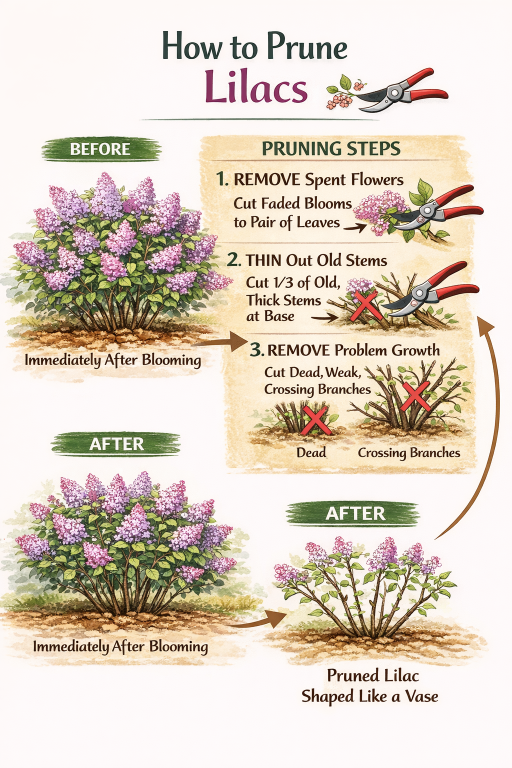
- Start by removing faded flower clusters. This prevents the plant from wasting energy producing seeds and helps direct energy into next year’s buds. Cut just above a healthy pair of leaves.
- Older lilacs also benefit from thinning. Every year, remove about one-third of the oldest thick stems at ground level. This gradual renewal keeps the shrub vigorous, improves airflow, and allows sunlight into the center.
-
At the same time, remove:
- - dead branches
- - weak stems
- - crossing growth
- The best lilac structure resembles an open vase—airy rather than dense.
- One important thing to know: lilacs dislike aggressive shearing. Heavy top-pruning often produces a mass of leafy shoots but fewer flowers.
-
- Rejuvenating an Old Lilac
- Many old lilacs become woody and bloom only at the top. Fortunately, they respond beautifully to patient restoration.
-
The gentlest method takes three years:
- Year 1 — remove one-third of the oldest stems
- Year 2 — remove another third
- Year 3 — remove the remaining oldest stems
- This gradually renews the shrub without eliminating all blooms at once.
- There is also a dramatic alternative: cutting the entire shrub down to about 6–12 inches above the ground. Lilacs usually recover well, but flowering may stop for one or two years while the plant rebuilds.
- Growing Conditions That Lilacs Love
- Lilacs are not difficult plants, but they do insist on sun.
-
For heavy flowering they need:
- - at least 6 hours of direct sun daily
- - good airflow
- - well-drained soil
- They especially dislike crowded or shady conditions. Too much shade results in healthy green growth—but very few flowers.
- Lilacs also prefer slightly alkaline soil, which explains why they thrive so beautifully in many old cottage gardens with limestone-based soils.
- Feeding Lilacs Without Overdoing It
- Lilacs are moderate feeders. Too much fertilizer—especially nitrogen—creates lush leaves instead of blooms.
- Gardeners often unknowingly cause flowering problems by using lawn fertilizer nearby. Lawn fertilizers are usually nitrogen-heavy, and lilacs respond with vigorous leafy growth but poor flowering.
- For better blooming, use low-nitrogen fertilizers with balanced formulas such as 5-10-10 or 10-10-10.
- Together, they create a garden that is not only beautiful, but also cohesive in its needs.
- Feed once in early spring before active growth begins. In poor soil, a second very light feeding after flowering can help the shrub recover and form buds for the following year.
- Spread fertilizer around the drip line rather than against the trunk, lightly work it into the soil, and water thoroughly afterward.
- Watering and General Care
- Established lilacs are fairly drought tolerant, but young shrubs benefit from regular watering while establishing roots.
- Mulch helps retain moisture and suppress weeds, but keep mulch away from the base of stems to prevent rot.
- Lilacs also tend to produce suckers from the roots. Some gardeners remove them to keep the shrub tidy, while others allow them to form natural thickets.
- Why Lilacs Sometimes Refuse to Bloom
-
A lilac covered in leaves but lacking flowers is usually trying to tell you something. The most common causes are:
- - pruning at the wrong time
- - too much shade
- - excess nitrogen fertilizer
- - overcrowded old stems
- In many cases, a lilac simply needs more sunlight and gradual rejuvenation pruning.
-
A lilac covered in leaves but lacking flowers is usually trying to tell you something. The most common causes are:
- Beautiful Ways to Use Lilacs
- Lilacs are not only ornamental—they can also be used in surprisingly creative ways.
-
Their flowers are edible in small amounts and are sometimes:
- infused into syrups
- used in sugar or honey
- added to teas
- crystallized for desserts
- Lilac syrup has a delicate floral flavor and pale lavender color that is especially popular in spring drinks.
- Lilac blossoms can also be used in homemade sachets, soaps, and potpourri because of their fragrance.
- Historically, lilacs were often planted near entrances, porches, and windows—not only for beauty, but because people believed their scent symbolized hospitality and the return of spring.
- Companion Plants That Extend the Season
- Lilacs bloom gloriously—but briefly. Pairing them with the right plants creates a garden that evolves beautifully through the seasons.
-
Spring bulbs such as:
- Tulipa
- Narcissus
- Hyacinthus create layered spring displays beneath lilacs.
-
As lilacs fade, perennials take over:
- Paeonia
- Iris germanica
- Nepeta
- Salvia nemorosa
- Alchemilla mollis Summer-flowering plants like:
- Echinacea purpurea
- Phlox paniculata
- Rudbeckia hirta
- Hemerocallis help keep the border colorful long after lilac season ends.
- Lilac syrup has a delicate floral flavor and pale lavender color that is especially popular in spring drinks.
- Lilac blossoms can also be used in homemade sachets, soaps, and potpourri because of their fragrance.
- Historically, lilacs were often planted near entrances, porches, and windows—not only for beauty, but because people believed their scent symbolized hospitality and the return of spring.
Lilacs are plants that reward patience. They are not fast, tropical, or flashy in the modern sense. Instead, they become more beautiful with time—larger, more fragrant, and more deeply connected to the garden each passing year.
A well-grown lilac is not simply a shrub in bloom. It becomes part of the memory of spring itself.