Peonies (Paeonia) are among the most beloved and enduring garden perennials in the world. They are plants of patience and permanence—shrubs and herbaceous clumps that can live for decades, sometimes even a century, producing larger and more beautiful blooms with age rather than declining.
A mature peony in bloom has a presence unlike almost any other perennial. The flowers can be enormous, fragrant, and impossibly delicate-looking, yet the plant itself is remarkably resilient. Once established, peonies ask for surprisingly little in return.
And perhaps that is part of their charm: peonies reward gardeners who understand restraint.
- A Flower of Emperors, Legends, and Old Gardens
- Peonies have been cultivated for more than 2,000 years. In ancient China, they were considered so magnificent that they became known as the “King of Flowers.”
- During the Tang Dynasty, peonies were grown in imperial gardens and symbolized wealth, honor, beauty and prosperity.
- Some rare varieties were so valuable that only nobles and wealthy families could afford them.
- In Chinese art, peonies frequently appeared in paintings, embroidery, and porcelain. Even today, they remain symbols of abundance and good fortune.
- The plant’s botanical name, Paeonia, also has roots in mythology. According to Greek legend, the physician Paeon used peonies medicinally to heal the gods. Out of jealousy, his teacher Asclepius threatened him, and Zeus transformed Paeon into the peony flower to save him.
- For centuries, peonies were valued not only for beauty, but also for medicine. Historically, roots and seeds were used in traditional remedies, though modern gardeners now grow them mainly for ornament and fragrance.
- Why Peonies Are So Long-Lived
- One of the remarkable things about peonies is how deeply they dislike disturbance. Unlike many perennials that need frequent dividing, peonies often grow better when left alone for years.
- A healthy peony planted correctly can bloom beautifully for decades in the same spot. That permanence is part of why old peony clumps are often found near abandoned homes and historic gardens—they outlive generations of gardeners.
- Choosing the Right Place
- Peonies love sunlight, fresh air, and stability.
-
They bloom best in:
- - full sun for at least 6–8 hours daily
- - rich but well-drained soil
- - locations with good airflow
- In very hot climates, light afternoon shade can help blooms last longer.
- Good air circulation matters more than many gardeners realize. Dense, humid conditions encourage fungal problems, especially botrytis and powdery mildew.
- Peonies also dislike soggy soil. Their thick roots store energy and moisture, so constantly wet ground can lead to rot.
- Planting Peonies Correctly
-
If there is one famous peony rule, it is this: Do not plant them too deeply. This single mistake is responsible for countless healthy-looking peonies that never bloom.
Peony roots contain growth buds called “eyes.” These buds must sit close to the soil surface—usually only about 1–2 inches deep.
-
Why does depth matter so much?
Peonies depend on seasonal temperature changes to trigger flowering. The buds need to experience winter chilling followed by spring warming. When buried too deeply, the soil stays cooler and the signals become weaker or delayed.
The result is frustrating but common:
- - lush leaves
- - strong stems
- - no flowers
Gardeners often assume the plant needs fertilizer, but the real problem is simply planting depth.
-
- How to Plant Peonies
-
Preparing the planting hole properly helps peonies establish for decades.
Dig a wide hole and lightly enrich the soil with compost or organic matter. Avoid creating an overly rich pocket of soil, since peonies prefer stable conditions rather than excessive fertility.
- Place the root carefully so the buds sit just below the surface. Then backfill gently and water deeply.
- Unlike many perennials, peonies should not be buried heavily under mulch.
-
- Feeding Peonies Without Overfeeding
-
Peonies are moderate feeders—not hungry plants.
Over-fertilizing is one of the most common mistakes gardeners make, especially with nitrogen-heavy products. Excess nitrogen creates huge leafy plants with few flowers.
-
Peonies are moderate feeders—not hungry plants.
Over-fertilizing is one of the most common mistakes gardeners make, especially with nitrogen-heavy products. Excess nitrogen creates huge leafy plants with few flowers.
-
A balanced fertilizer such as 10-10-10 or 5-10-10 works well in early spring as new shoots emerge.
Organic gardeners often prefer compost or aged manure, which provide slower, gentler nutrition.
- During bud formation, some gardeners apply a low-nitrogen fertilizer with higher phosphorus levels. Why phosphorus? Because phosphorus supports flower formation, root strength and energy storage. This is why fertilizers labeled for flowering plants often contain higher middle numbers.
- However, peonies generally do not require aggressive feeding. They prefer consistency and moderation.
-
- Feeding After Bloom
-
After flowering, many gardeners lose interest in peonies because the dramatic blooms are gone. But this is actually when the plant begins preparing for next year. The leaves continue collecting energy and storing it in the roots. A light feeding after bloom helps support root development, bud formation for the following season and overall plant longevity.
This is also why cutting foliage too early weakens future flowering.
-
- Watering Peonies
- Peonies prefer deep watering rather than constant shallow moisture.
- During spring growth and bud formation, evenly moist soil helps produce larger, healthier blooms. But once established, peonies are fairly resilient.
- Overwatering is usually more dangerous than temporary dryness.
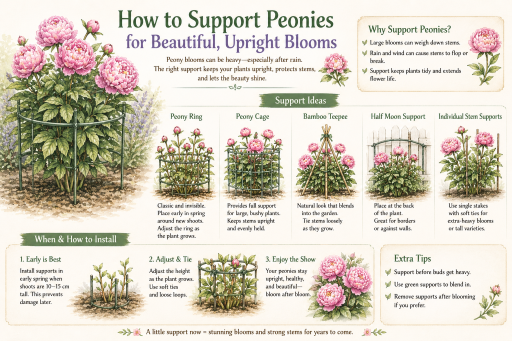
- Why Peonies Need Support
- Large-flowered peonies can become extremely heavy, especially after rain.
- This is why experienced gardeners often install supports early in spring, before the plant becomes large. Once hidden by foliage, supports become nearly invisible while preventing stems from collapsing.
- Historically, elaborate metal peony rings were common in formal European gardens because the blooms were considered too precious to let fall onto the ground.
- Pruning and Seasonal Maintenance
- After blooming, remove faded flowers—but leave the foliage intact. This is one of the most misunderstood parts of peony care. The leaves are not “finished” after flowering. They continue feeding the roots all summer.
- In fall, however, peonies should be cut back completely to ground level. Why? Because old foliage can harbor fungal diseases through winter, especially botrytis. Removing plant debris breaks the disease cycle and dramatically improves plant health the following year.
- Ants on Peony Buds: The Famous Myth
-
Interestingly, old garden folklore often treated ants on peonies as a sign of healthy blooms and good luck.
Many people believe ants are necessary for peonies to bloom. This is not true—but the myth has existed for generations. Ants are attracted to the sweet nectar on peony buds, not because they help open the flowers, but simply because they enjoy the sugary coating.
- The good news: ants do not harm peonies. In most cases, no treatment is needed. If you cut flowers for indoors, gently rinse or shake off the ants first
-
- Common Problems
- Peonies are generally sturdy plants, but poor airflow and excess moisture can lead to disease.
-
Botrytis (Gray Mold)
This fungal disease causes: blackened buds, rotting stems and collapsing growth.
It thrives in cool, damp conditions.
Improving airflow and removing infected material is the first line of defense. Severe cases may require fungicide treatment.
-
Powdery Mildew
This appears as a white coating on leaves, especially late in the season.
Although often more cosmetic than deadly, it weakens plant appearance and can reduce vigor over time.
Good spacing, airflow, and occasional sulfur or neem treatments help prevent it.
- Seasonal Rhythm of Peonies
- Peonies follow a beautiful yearly cycle.
- In early spring, reddish shoots emerge dramatically from the soil like something prehistoric.
- By late spring, enormous buds swell and open into spectacular flowers.
- Summer is quieter—the plant focuses on storing energy.
- Fall is cleanup season.
- Winter is complete dormancy.
- Understanding this rhythm helps gardeners work with the plant rather than against it.
- Companion Plants That Pair Beautifully with Peonies
- Peonies combine especially well with plants that enjoy similar conditions and complement their flowering season.
-
Classic companions include:
- Iris germanica
- Nepeta
- Salvia nemorosa
- Alchemilla mollis
- These plants help extend seasonal interest before and after peony bloom.

Peonies teach gardeners patience. They are not plants for instant results or constant rearranging. Instead, they settle slowly into the garden, becoming more magnificent year after year. And perhaps that is why people become so attached to them. A mature peony bush blooming in late spring does not feel temporary. It feels timeless.