Pruning Roses: Climbing
How to Prune Climbing Roses
(USDA Hardiness Zone 6: average winter lows about –10°F / –23°C)
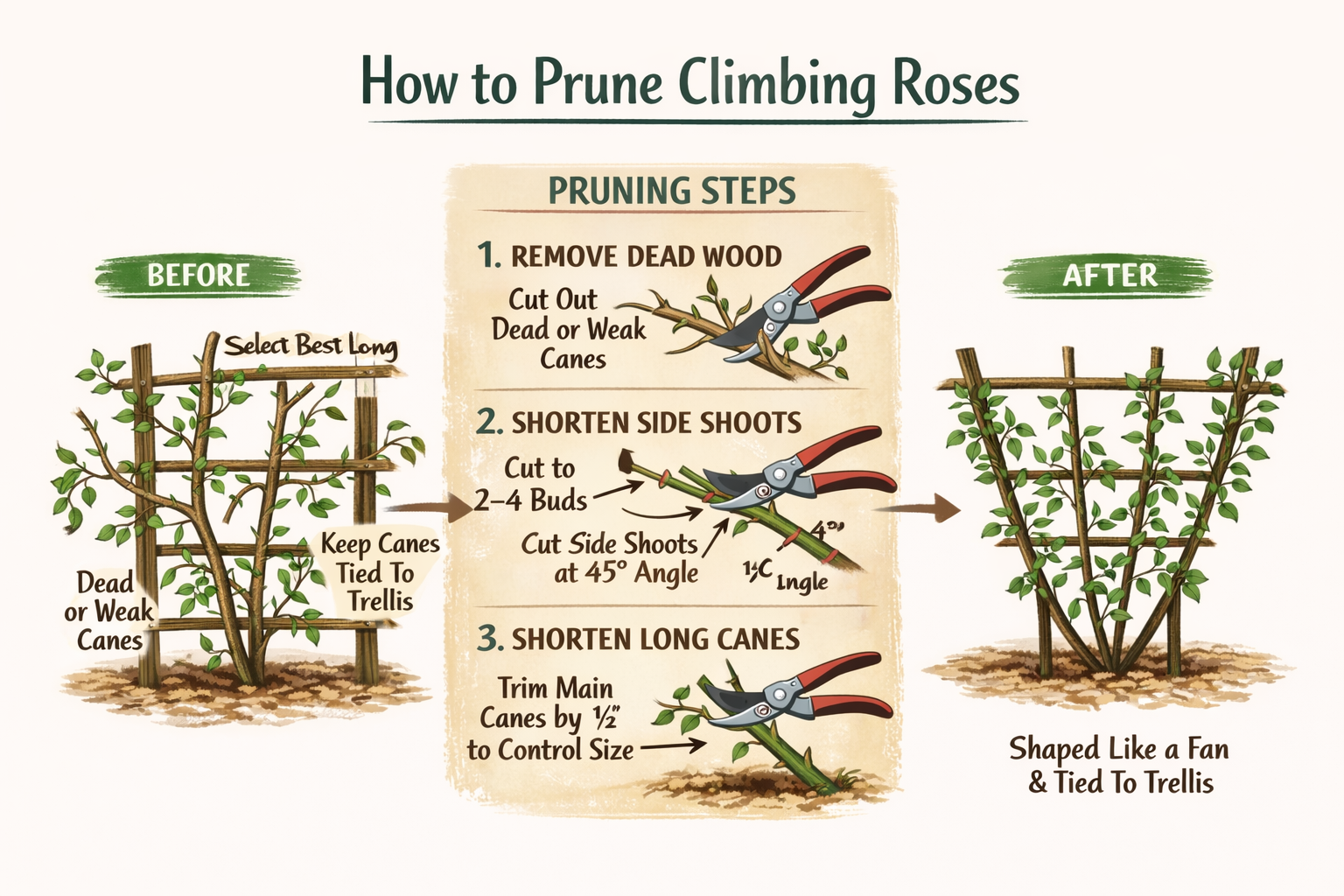
Climbing roses bloom best when their main canes are preserved and trained horizontally, while the side shoots are pruned to encourage flowers.
(USDA Hardiness Zone 6: average winter lows about –10°F / –23°C)
Climbing roses bloom best when their main canes are preserved and trained horizontally, while the side shoots are pruned to encourage flowers.
- 1. Remove Dead and Damaged Wood
- - Cut out dead, diseased, or broken canes completely.
- - Remove thin or weak stems that cannot support flowers.
- - Cut back to healthy green wood.
- 2. Keep the Main Structural Canes
This improves air circulation and light penetration.
- - Select 3–6 strong main canes growing from the base. These long canes form the permanent structure of the climbing rose. Do not cut these back heavily.
- 3. Remove Old or Unproductive Canes
- - If a cane is very old, woody, or not producing flowers, remove it at the base. This encourages new strong replacement shoots from the bottom.
- 4. Prune the Side Shoots
- - Cut the lateral (side) shoots growing from the main canes back to 2–4 buds (about 4–6 inches / 10–15 cm).
- - Make the cut ¼ inch above an outward-facing bud. These short side shoots are where most flowers will grow.
- 5. Train and Tie the Canes
- - Gently bend the long main canes horizontally or in a fan shape.
- - Tie them to a trellis, fence, or arch with soft ties.
- - Horizontal training encourages more flowering shoots.
- 6. Remove Crossing or Crowded Growth
- - Cut out stems that cross, rub, or overcrowd the plant.
- - Keep the structure open and evenly spaced.
- After pruning the climbing rose should have 3–6 strong horizontal main canes, with short pruned flowering side shoots spaced along them. This structure allows the plant to produce many flowering stems along the entire length of the canes.
Rose Care