Pruning Roses: Shrubs
How to Prune Shrub Roses
(USDA Hardiness Zone 6: average winter lows about –10°F / –23°C)
Shrub roses are generally hardy, vigorous bushes. Pruning keeps them healthy, open, and productive, while controlling their size.
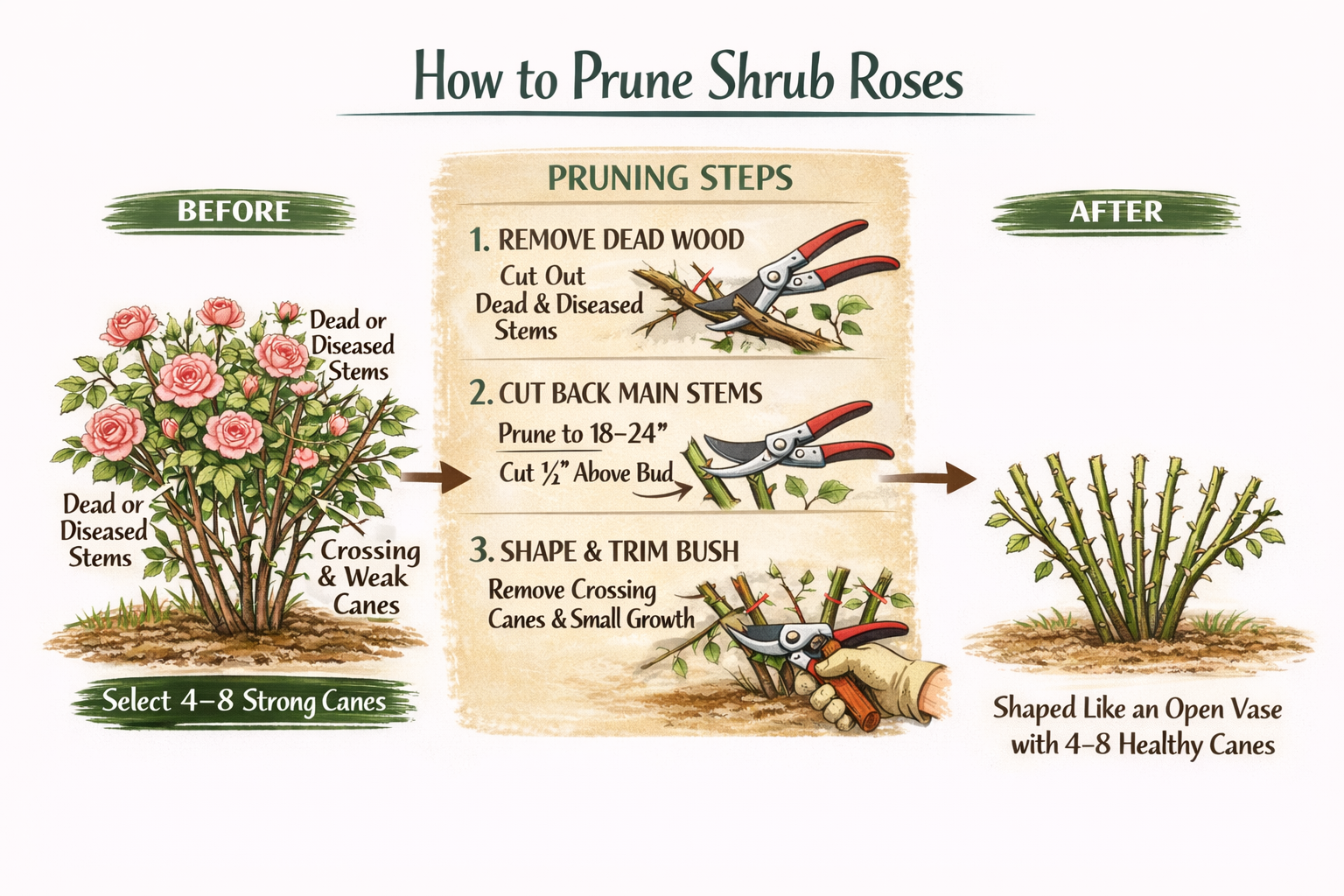
(USDA Hardiness Zone 6: average winter lows about –10°F / –23°C)
Shrub roses are generally hardy, vigorous bushes. Pruning keeps them healthy, open, and productive, while controlling their size.
- 1. Remove Dead, Damaged, and Diseased Wood
- - Cut out dead, dry, or blackened canes completely.
- - Remove any diseased or broken branches.
- - Cut back to healthy green wood.
- 2. Remove Weak and Crowded Stems
- - Cut out thin, weak stems that cannot support flowers.
- - Remove branches that cross or rub against each other.
- - Clear some growth from the center for better airflow.
- 3. Keep the Main Framework
- - Select 4–7 strong, healthy canes growing from the base. These should grow outward in different directions.
- 4. Cut Back the Remaining Canes
- - Reduce the height of the plant by about ½ of its height.
- - Make each cut ¼ inch (5–7 mm) above an outward-facing bud.
- - Cut at a 45° angle.
- 5. Shape the Bush
- - Aim for an open vase shape.
- - Keep the center slightly open to allow sunlight and air circulation.
- 6. Remove Small Twiggy Growth
- - Trim away tiny inner shoots that produce weak flowers. This encourages stronger flowering stems
- After pruning the shrub should have 4–7 strong canes, an open center, and a balanced shape, allowing the plant to produce healthy new shoots and abundant blooms.
Typical height after pruning
| Medium shrub roses | Large shrub roses |
|---|---|
| about 12–24 in (30–60 cm) | about 18–30 in (45–75 cm) |
How to Prune Shrub Roses (Such as David Austin Roses)
(USDA Hardiness Zone 6: average winter lows about –10°F / –23°C)
Shrub roses grow naturally fuller and wider than hybrid tea roses, so pruning is lighter and focused on shaping rather than hard cutting.
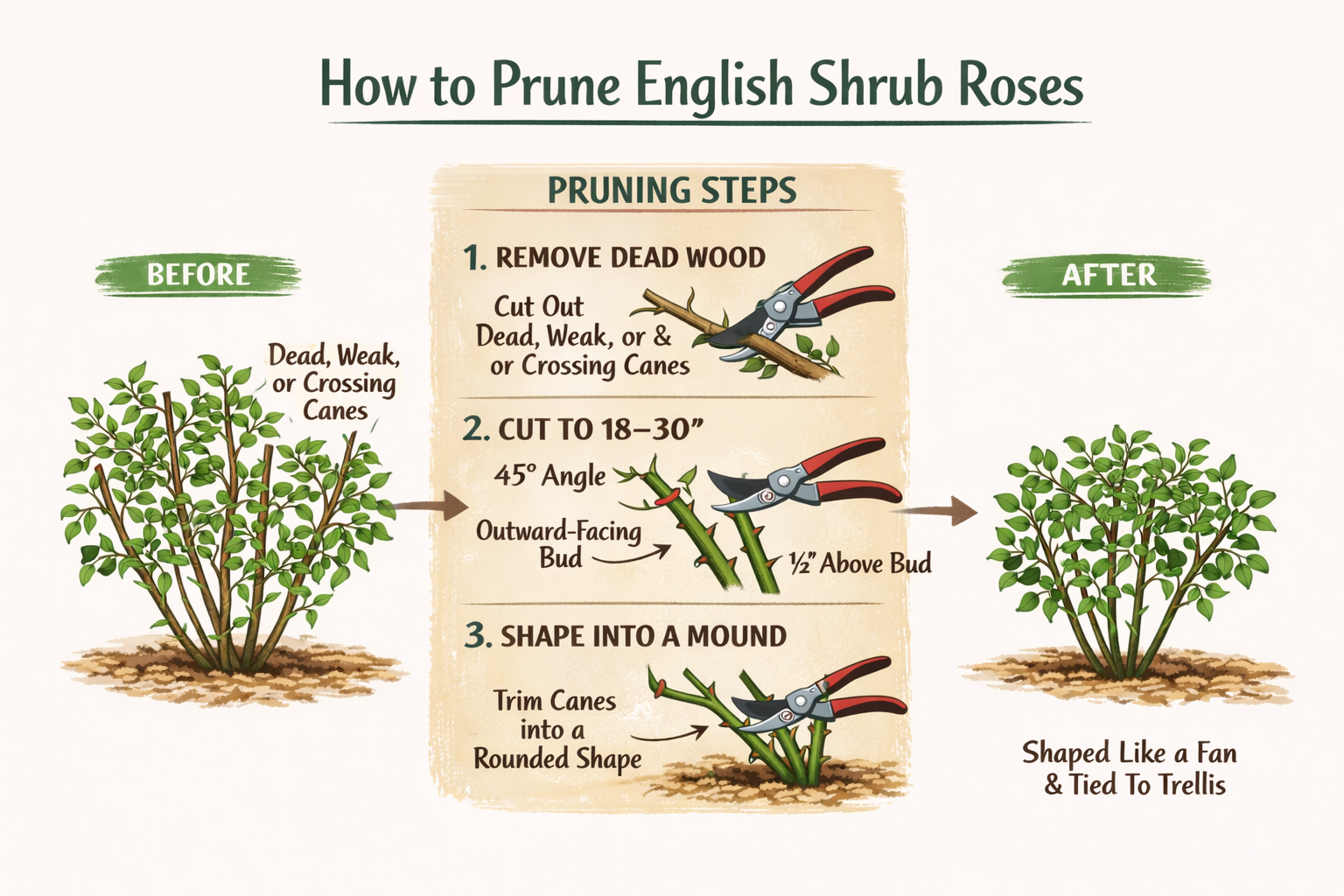
(USDA Hardiness Zone 6: average winter lows about –10°F / –23°C)
Shrub roses grow naturally fuller and wider than hybrid tea roses, so pruning is lighter and focused on shaping rather than hard cutting.
- 1. Remove Dead, Damaged, and Diseased Wood
- - Cut out dead, blackened, or dry canes completely.
- - Remove thin, weak stems that cannot support flowers.
- - Cut back to healthy green wood.
- 2. Remove Crossing and Inward-Growing Branches
- - Remove stems that cross, rub, or grow toward the center of the bush.
- - Open the middle of the plant so air and sunlight can reach inside. This helps prevent diseases.
- 3. Keep the Strongest Canes
- - Select 5–8 strong, healthy canes that form the structure of the plant. These should grow outward in different directions.
- 4. Shorten the Remaining Canes
- - Reduce the height of the bush by about ⅓ to ½.
- - Make each cut ¼–½ inch above an outward-facing bud.
- - Cut at a 45° angle so water runs off the cut.
Typical height after pruning
Medium shrub roses Large shrub roses about 12–24 in (30–60 cm) about 18–30 in (45–75 cm) - 5. Shape the Bush
- - Aim for a soft open vase shape
- - Keep the center slightly open but not too sparse—Austin roses look best full and rounded.
- 6. Remove Small Inner Growth
- - Trim out tiny twiggy stems inside the plant. This directs energy to strong flowering shoots.
- After pruning the shrub should have 5–8 strong outward-growing canes, a balanced rounded shape, and plenty of space in the center for light and airflow.
Shrub Roses vs Austin Roses
Typical height after pruning
| Bush (Shrub) Roses | Austin Roses |
|---|---|
| Remove dead, diseased, and weak wood. | Remove dead and weak stems. |
| Remove crossing or inward-growing branches. | Lightly thin crowded growth. |
| Cut strong canes back by ½ to control size. | Shorten remaining canes by ⅓. |
| Keep 4–7 main canes. | Keep 5–8 strong canes. |
| Aim for an open vase structure. | Maintain a rounded, natural shrub shape. |
| This type of pruning keeps the plant compact and well-ventilated. | Austin roses look best slightly fuller, so heavy pruning can reduce their characteristic form. |
- Simple rule gardeners use:
- - Shrub roses: prune for structure and control
- - Austin roses: prune for shape and flowering
Rose Care